


ProbeNet Q2 2026 Expansion: Deep North American Coverage, New Pacific Island Points of Presence, and a Sharper Network
Get Unlimited Access to IPinfo Lite
Start using accurate IP data for cybersecurity, compliance, and personalization—no limits, no cost.
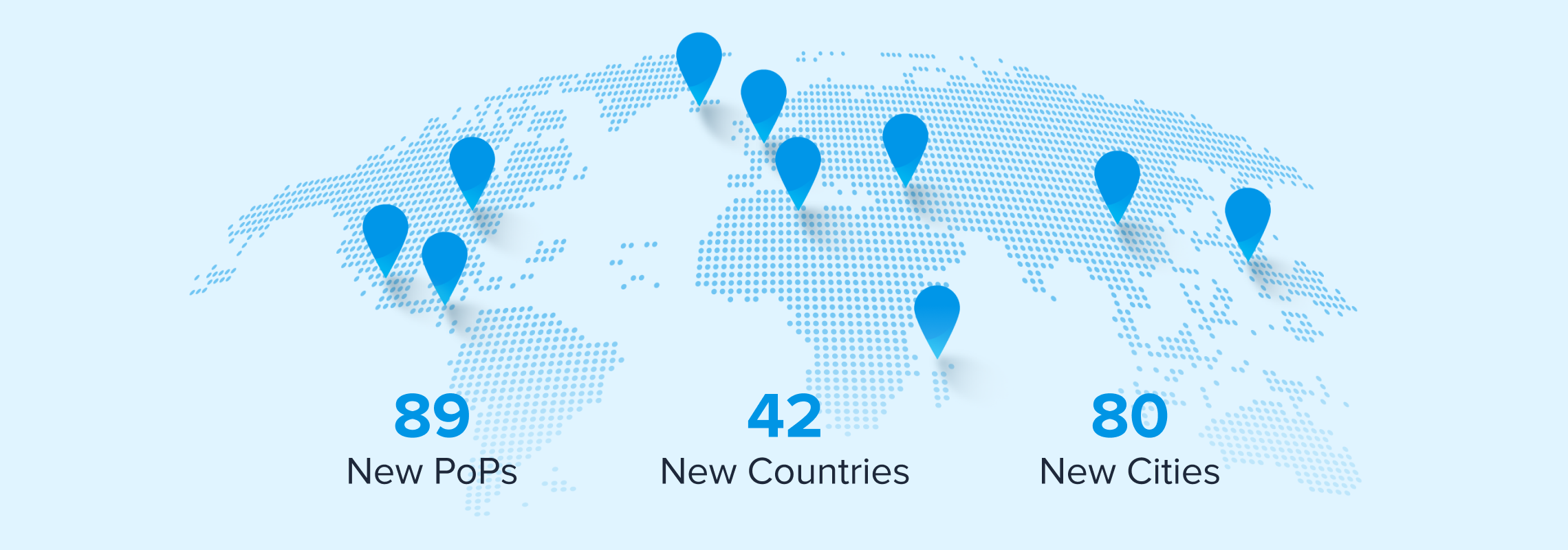
Sign up for freeProbeNet, the global measurement platform behind IPinfo's data, accelerated again in Q2 2026: 89 new monitoring PoPs across 42 countries and 80 cities, up 33% from Q1's 67 deployments. Where Q1 focused on island territories and frontier markets, Q2's theme was depth: dramatically densifying our North American footprint across underserved metros, sustaining Africa's momentum, and adding four new countries and territories to the network.
ProbeNet now stands at 1,363 active PoPs across 167 countries and territories. And just as importantly, it's a curated network: alongside the 89 deployments, we retired 82 underperforming or redundant PoPs during the quarter, most of them in already-dense European hubs. Every point of presence that remains earns its place, and every measurement feeds directly into the accuracy of our IP geolocation data.
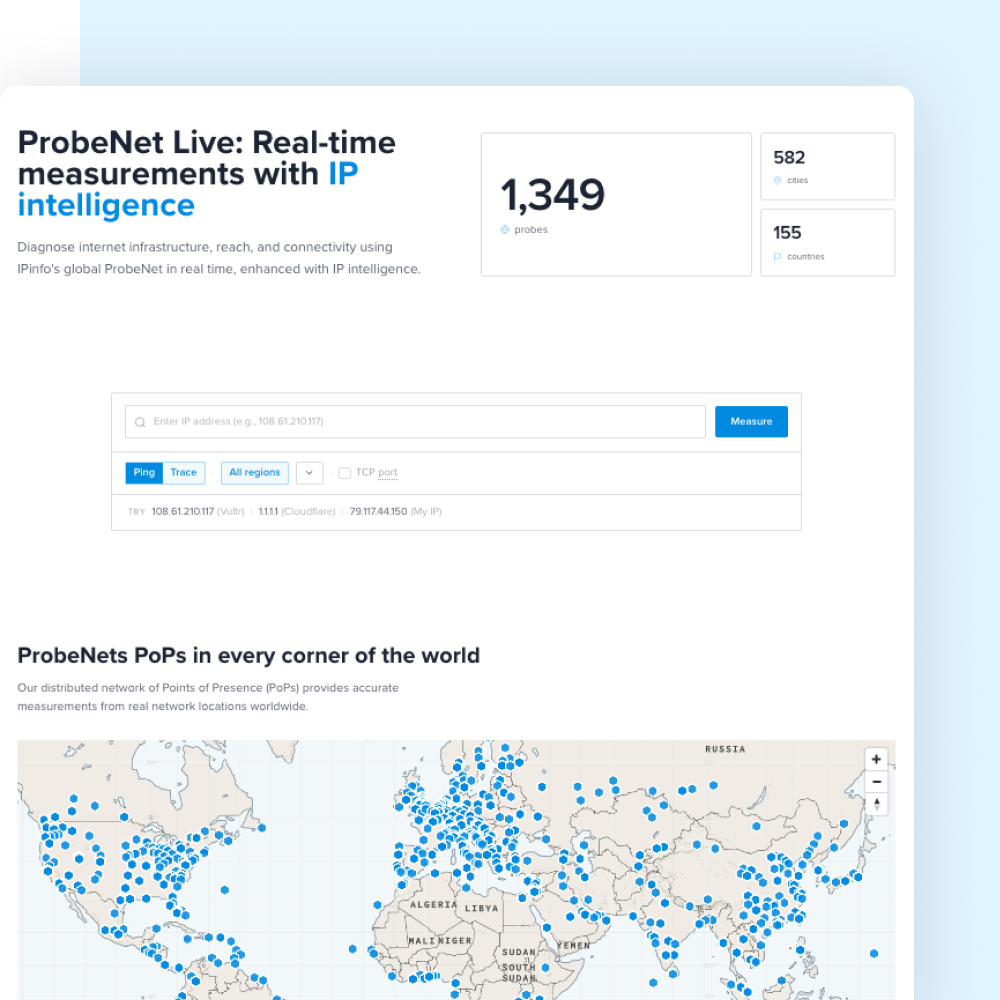
Try ProbeNet Live
Run latency, traceroute, and ping tests from any ProbeNet location with our free measurement tool.
Geographic Expansion: North American Depth, African Momentum, and New Island Points of Presence
Three stories define Q2:
1. Deep coverage across North America. 41 of our 89 new PoPs (46.1%) landed in North America, 37 of them in the United States alone, making it the fastest-growing continent in the network this quarter (+9.3%). The centerpiece is a coordinated deployment wave adding IPv6-enabled points of presence in more than 20 metros: Billings, Casper, Amarillo, Cedar Rapids, El Paso, Jackson, McAllen, Spokane, and more. This gives ProbeNet measurement coverage from inside the networks where American internet traffic actually flows, not just the coastal hubs.
2. Africa keeps compounding. 11 new PoPs spanned Accra, Nairobi, Mombasa, Dar es Salaam, Tunis, Oran, Kigali, Harare, and Grand-Bassam, plus our first PoP in Mayotte. After Q1's surge, Africa again grew faster than the network average.
3. New island and microstate coverage. Continuing Q1's island strategy, Q2 added our first-ever points of presence in Fiji (Suva), Vanuatu (Port-Vila), Mayotte (Mamoudzou), and Monaco: geographies where IP geolocation is hardest to verify and third-party ground truth is scarcest.
Continental Distribution of Q2 Deployments
(Three additional containerized measurement PoPs in Frankfurt, Tokyo, and New Jersey round out the 89.)
Net of Q2's curation work, the fastest-growing continents were North America (+9.3%), Oceania (+5.3%), and Africa (+4.2%), while European coverage was deliberately consolidated: we retired redundant PoPs in over-served hubs like Amsterdam, Frankfurt, and London-area data centers while adding new cities such as Zürich, Reykjavík, and Monaco.
Top Countries by Q2 Deployment
- 🇺🇸United States: 37 (the coordinated metro wave plus independent providers in cities like Madison, Milwaukee, Ogden, Indianapolis, and Huntsville)
- 🇨🇦Canada, 🇮🇹Italy, 🇯🇵Japan, 🇰🇪Kenya, 🇬🇭Ghana, 🇷🇺Russia, 🇪🇸Spain, 🇹🇳Tunisia: 2 each
- Single deployments across 33 more countries, from 🇧🇩Bangladesh, 🇱🇰Sri Lanka, and 🇮🇶Iraq to 🇮🇸Iceland, 🇦🇲Armenia, and 🇬🇹Guatemala
The long tail is the point: 42 countries saw at least one new PoP this quarter.
New Countries and Territories Added in Q2
Four locations joined ProbeNet for the first time, bringing the network from 163 to 167 countries and territories:
- 🇫🇯Fiji (Suva)
- 🇻🇺Vanuatu (Port-Vila)
- 🇾🇹Mayotte (Mamoudzou)
- 🇲🇨Monaco
All four are exactly the kind of geography where verification matters most: small territories where IP ranges are routinely mislocated to neighboring countries by databases without local measurement capability. None of them had ever hosted a ProbeNet point of presence before.
New City Coverage: 32 First-Ever Points of Presence
Beyond new countries, Q2 brought ProbeNet to 32 cities that had never had coverage:
North America: Austin, El Paso, Albany, Spokane, Fresno, Birmingham, Amarillo, Billings, Casper, Cedar Rapids, Jackson, McAllen, Minnetonka, Palo Alto, San Francisco, Springfield, Warrenton, Carlstadt, Huntsville, Lethbridge (Canada), and Santiago de los Caballeros (Dominican Republic)
Europe: Zürich, Reykjavík, Monaco, and Albertslund (Denmark)
Asia: Xi'an (China), Sendai (Japan), and Kufa (Iraq)
Africa: Oran (Algeria) and Mamoudzou (Mayotte)
Oceania: Suva (Fiji) and Port-Vila (Vanuatu)
We also restored coverage in Nashville and Ogden, where earlier PoPs had been retired.
Strategic Infrastructure Development
Redundancy in key hubs. 225 cities now host multiple ProbeNet PoPs. New redundant coverage arrived in cities including Madrid, Istanbul, Milan, Stockholm, Tunis, Accra, Nairobi, and Grand-Bassam, so a single provider outage never blinds us in a strategic location.
Active network curation. A measurement network is only as good as its worst point of presence. In Q2 we retired 82 PoPs, consolidating redundant European coverage after a provider transition and removing probes that no longer met our reliability bar. Deploying and pruning in the same quarter keeps the network lean, current, and trustworthy.
IPv6 commitment continues. 56.2% of Q2 deployments (50 of 89) are IPv6-enabled, ahead of Q1's 52.2%. Every PoP in the US metro wave supports IPv6, keeping the network-wide share at roughly 59% as IPv6 adoption accelerates globally.
Provider diversity as a design principle. Q2 deployments used 46 infrastructure providers, 33 of them (72%) new to the ProbeNet ecosystem, ranging from national telecoms to regional hosting specialists and research institutions. No single provider, network, or data center operator represents a meaningful share of our measurement capability.
Academic partnerships expand. Four PoPs hosted by universities and research institutions came online in Q2, in Iraq, North Macedonia, the United States, and Japan. Academic points of presence sit in network environments commercial hosting can't replicate, and they support the research community's use of ProbeNet data.
Why This Matters: Better Points of Presence Make Better Verification
Every ProbeNet PoP is an active measurement source that verifies where IP addresses are actually located, not where registration records claim they are. Latency-based verification is only as good as the proximity of the nearest probe. Each new metro, island, and frontier market deployment shrinks the distance between our measurement infrastructure and the IP ranges we verify, which translates directly into geolocation accuracy our customers can trust for fraud prevention, content licensing, cybersecurity, and compliance.
The Q2 North American densification is a concrete example: points of presence now inside metros like Amarillo, Casper, and Cedar Rapids, we can distinguish IP ranges in neighboring cities and states that look identical from coastal measurement points alone.
Looking Forward
Q2 was about depth; the roadmap ahead balances depth with continued reach:
- Closing remaining coverage gaps in Central Asia, the Caribbean, and island geographies
- Extending the coordinated metro deployment model to additional regions
- Continuing Africa's momentum with more in-country partnerships
- Growing multi-PoP redundancy in high-value routing hubs
- Maintaining majority-IPv6 deployment as the network standard
"In the first half of 2026, we aggressively expanded our reach across Micronesia and Polynesia. Our maximum probe to probe distance is currently about 2,000 KM across the globe. In Q3, we will continue our expansion across islands and overseas territories and North Africa."
- Abdullah, Developer Relations at IPinfo
ProbeNet's measurements power every tier of IPinfo's data, and you don't have to take our word for the coverage. Try ProbeNet Live: pick any point of presence on the network, including this quarter's newest additions in Fiji, Vanuatu, and Monaco, and run your own latency, traceroute, and ping tests for free.
Share this article


About the author

As the product marketing manager, Fernanda helps customers better understand how IPinfo products can serve their needs.