


Get Unlimited Access to IPinfo Lite
Start using accurate IP data for cybersecurity, compliance, and personalization—no limits, no cost.
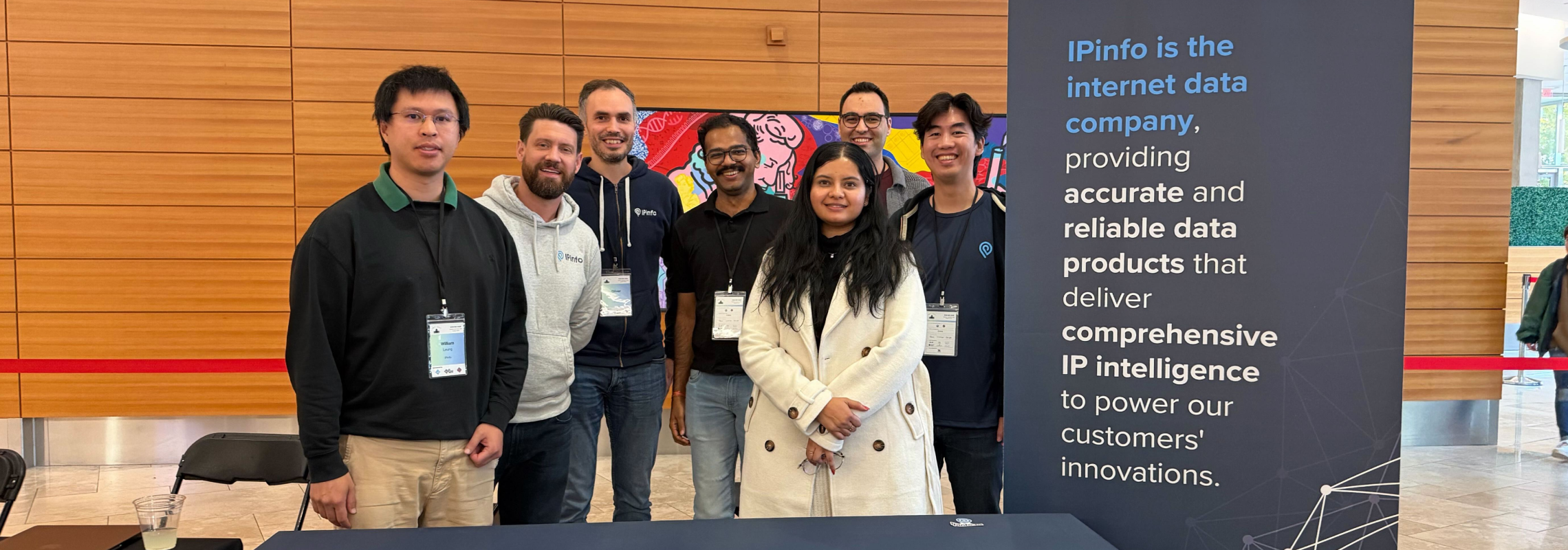
Sign up for freeThe 2025 Internet Measurement Conference (IMC) wrapped up with lots of fresh insights, plus a noticeable uptick in research powered by IPinfo data. We were also excited to be a Platinum Sponsor of this year’s conference.
Researchers cited or directly used IPinfo in 11 published papers — the most of any IP data provider this year. Compare that to just 3 papers two years ago. The trend is clear: IPinfo is becoming the default choice for data quality and reliability.
Provider mentions across IMC papers:
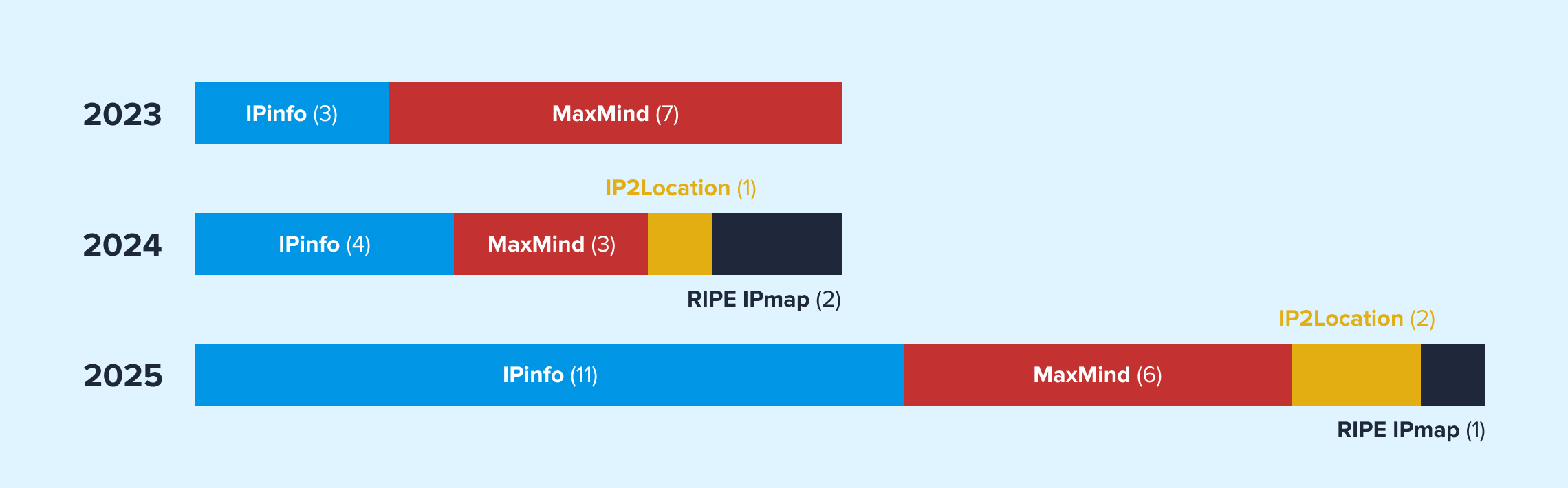
We’re proud to be the top IP provider choice for the research community.
Paper Highlights
This year’s IMC featured a wide range of research, some of which used IPinfo data. Below are a few standout studies. We’ve also included reflections on how some findings might shape future IPinfo capabilities.
Prefix2Org: Mapping BGP Prefixes to Organizations (Gouda et al.)
Used IPinfo’s organization-to-domain mappings after applying AS2Org. Their approach leverages RPKI similarities for clustering prefixes.
LACeS: An Open, Fast, Responsible and Efficient Longitudinal Anycast Census System (Hendriks et al.)
The team reached out to IPinfo directly to compare anycast prefix detection.
Tracking Internet Disruptions in Ukraine: Insights from Three Years of Active Full Block Scans (Holzbauer et al.)
This study used IPinfo data for bi-hourly full block scans to track internet blackouts. Even at that granularity, some events were missed, demonstrating the value of higher-frequency datasets.
Time To Scan: Digging into NTP-based IPv6 Scanning (Klopsch et al.)
These researchers deployed NTP servers to attract IPv6 clients. The study also flagged existing actors (academic + unknown) already doing this.
Replication: Characterizing MPLS Tunnels over Internet Paths (Huddleston et al.)
Revealed how MPLS tunnels can skew topology observations, potentially explaining some SNMPv3 alias anomalies.
Autonomous Systems under AReST: Advanced Revelation of Segment Routing Tunnels (Dekinder et al.)
Another report on MPLS detection, this time looking at SR-MPLS tunnels. They’ve released both the dataset and source code.
Roam Without a Home: Unraveling the Airalo Ecosystem (Yang et al.)
Explored the Airalo eSIM ecosystem, using both web and device-based campaigns to trace network behavior.
Learning AS-to-Organization Mappings with Borges (Selmo et al.)
Extracted clues from PeeringDB (like "aka" names), then used LLMs to enrich AS-to-organization relationships.
Somesite I Used To Crawl: Awareness, Agency and Efficacy in Protecting Content Creators From AI Crawlers (Liu et al.)
Investigated how websites respond to AI crawlers. While active blocking is rising, few use robots.txt rules. One implication: resistance is high, but inconsistent. Worth tracking given rapid LLM adoption.
I also presented sibling prefix research with Fariba Osali and K. Zubair Sediqi.
Posters Worth a Mention
The poster track delivered plenty of early-stage ideas and hands-on tools worth watching. Several touched on topics directly relevant to our work, from topology scanning to IPv6 behavior under VPNs. Here’s a quick roundup of those that caught our team’s attention.
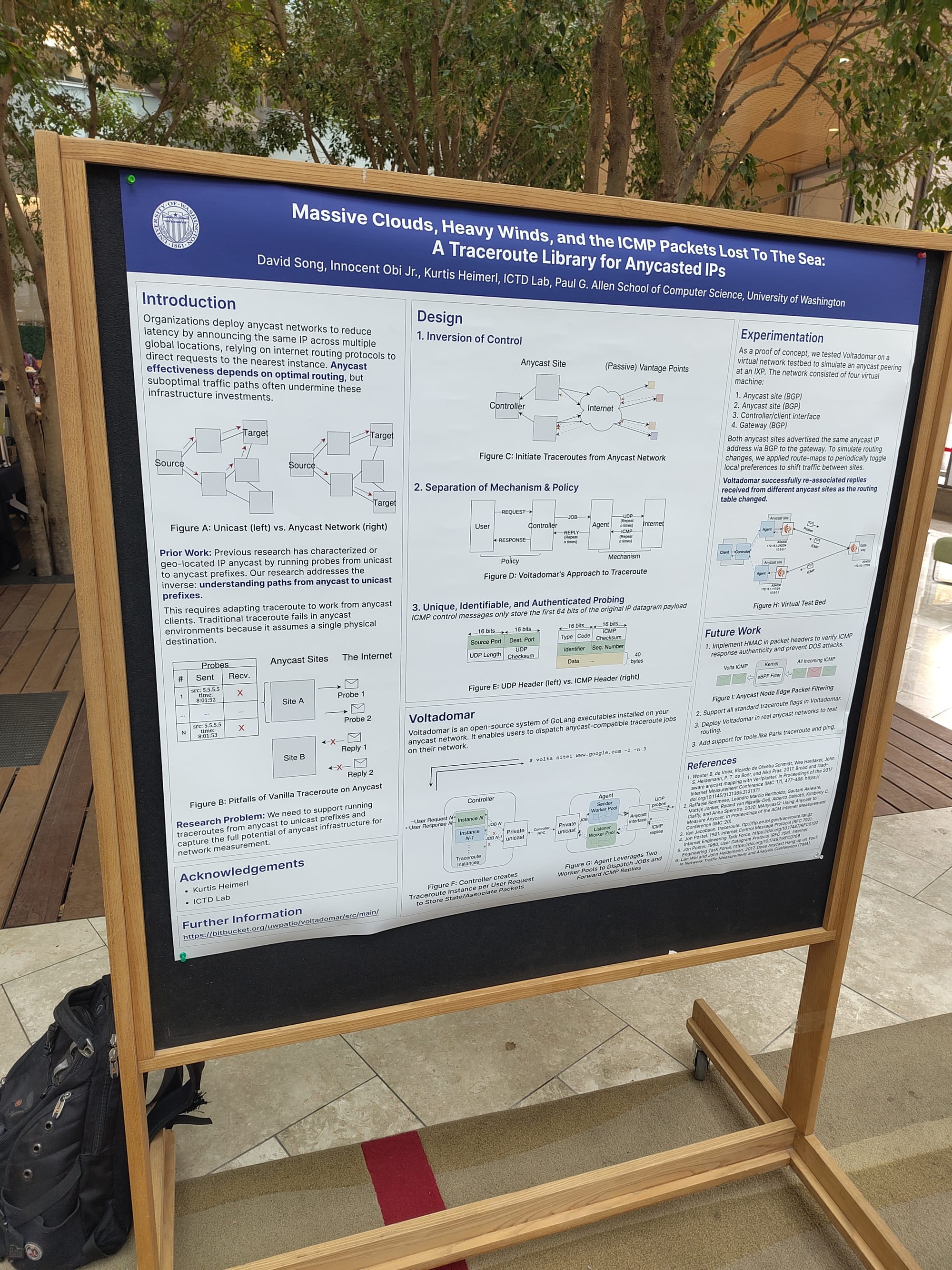
Voltadomar: A traceroute library for Anycasted IPs (Song et al.): New traceroute library targeting anycasted IPs.
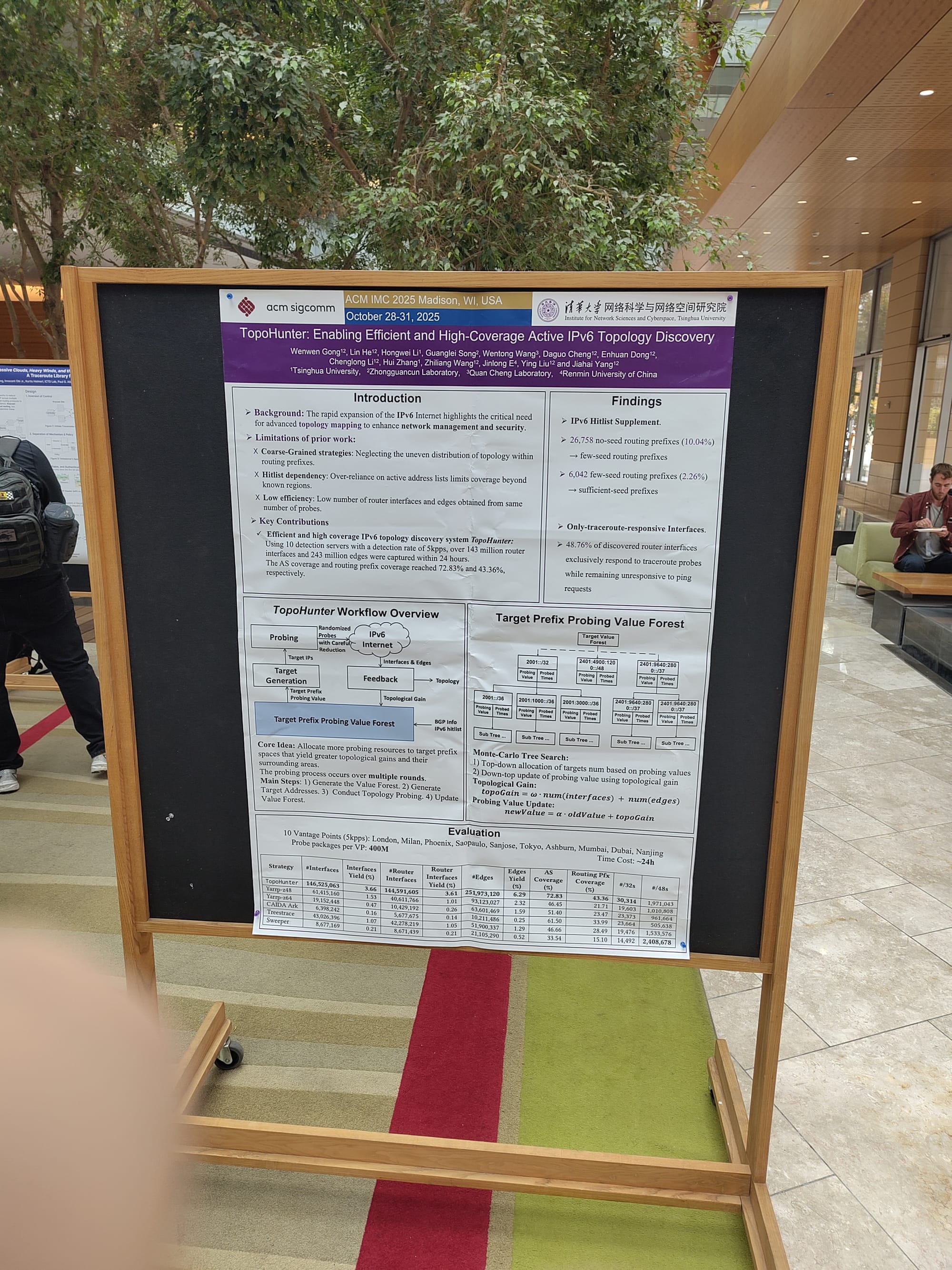
TopoHunter: Enabling Efficient and High-Coverage Active IPv6 Topology Discovery (Gong et al.): An MCTS-inspired IPv6 scanner, with probing policies tied to BGP tree structures.
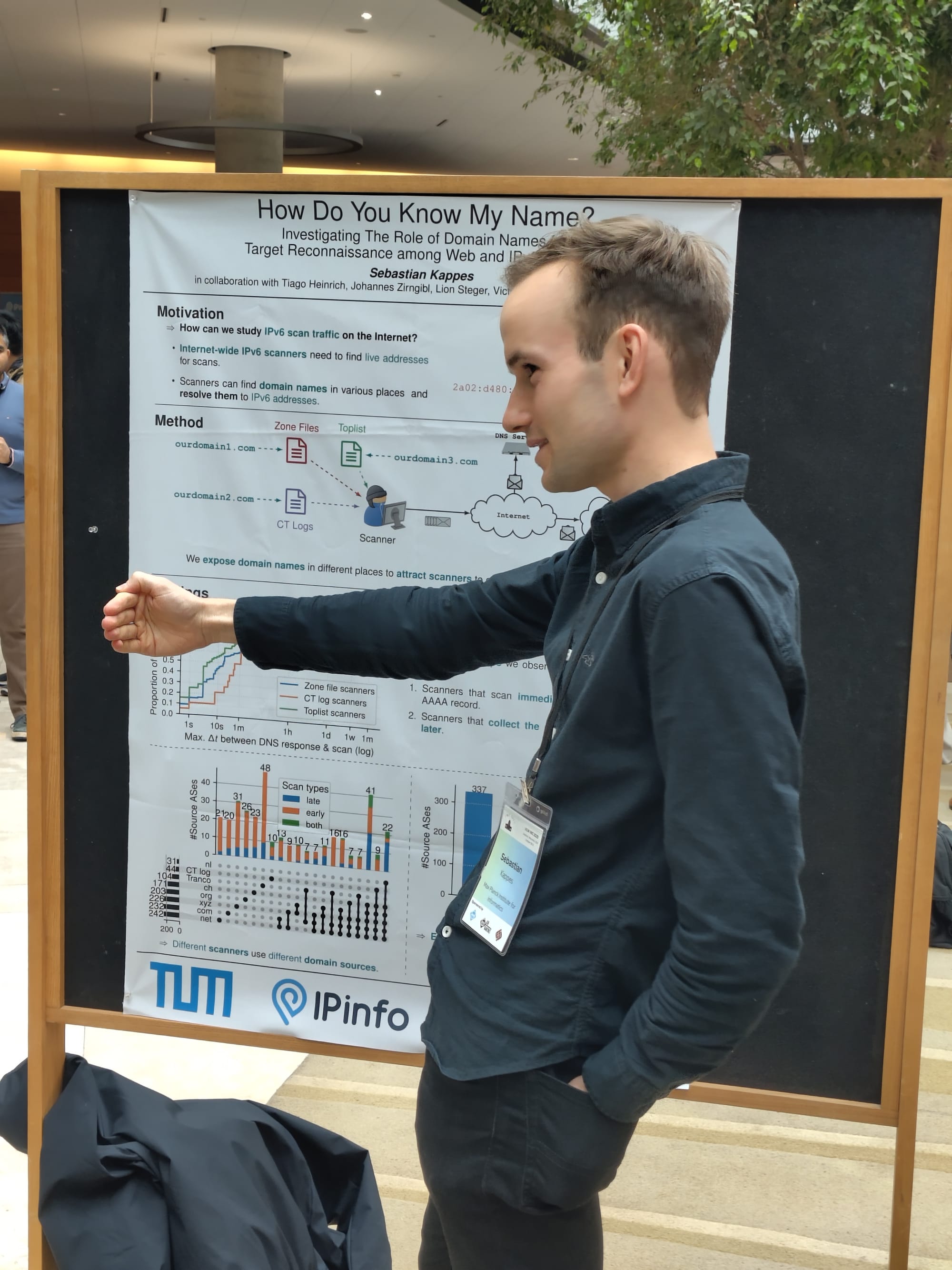
How Do You Know My Name? Investigating The Role of Domain Names for Target Reconnaissance among Web and IPv6 Scanners (Kappes et al.): Using scanners to find domain names in various places and resolving them to IPv6 addresses; IPinfo was collaborating on this poster as well.
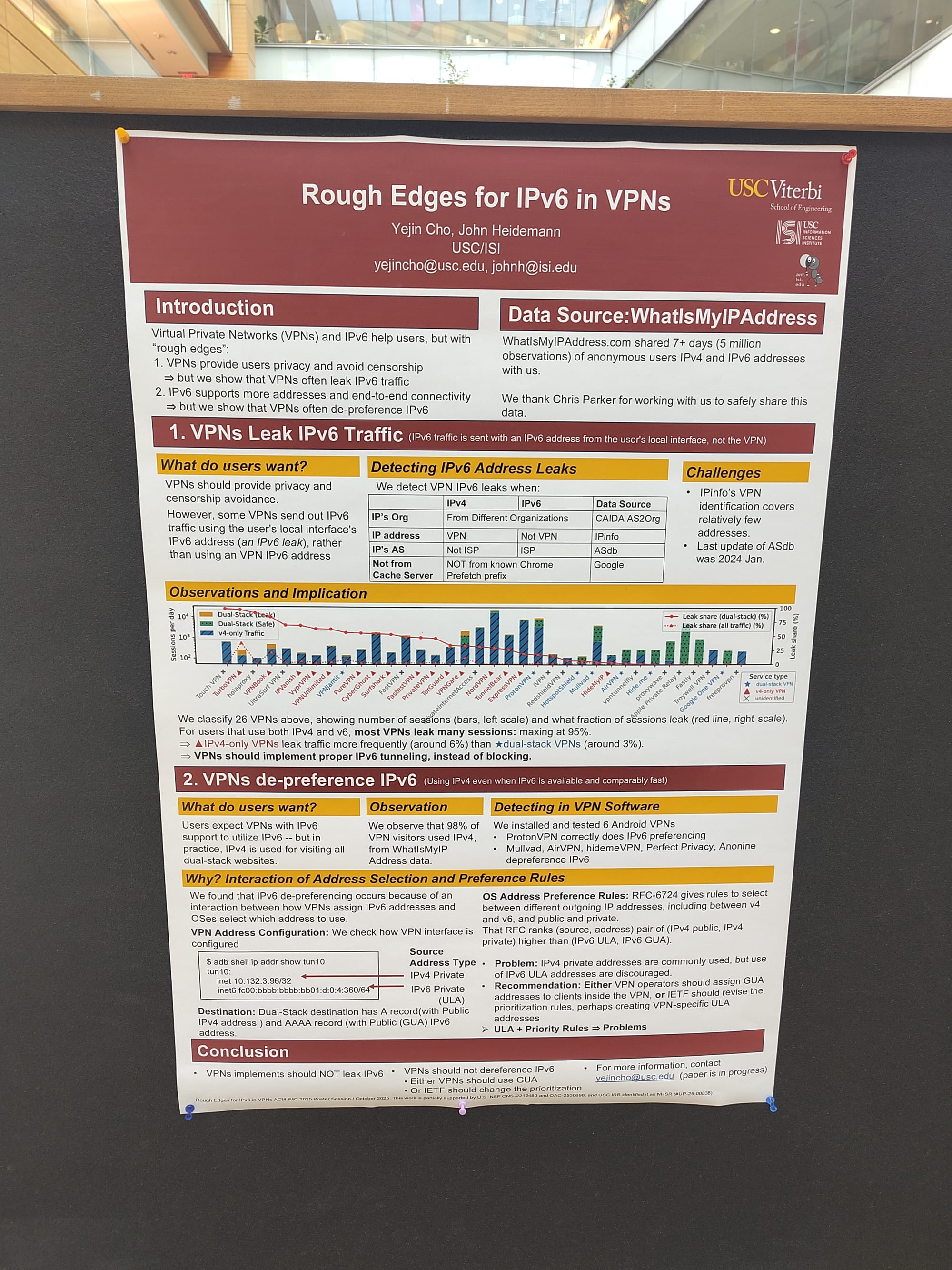
Rough Edges for IPv6 in VPNs (Cho et al.): Demonstrated that IPinfo is only seeing a small percentage of VPN addresses.
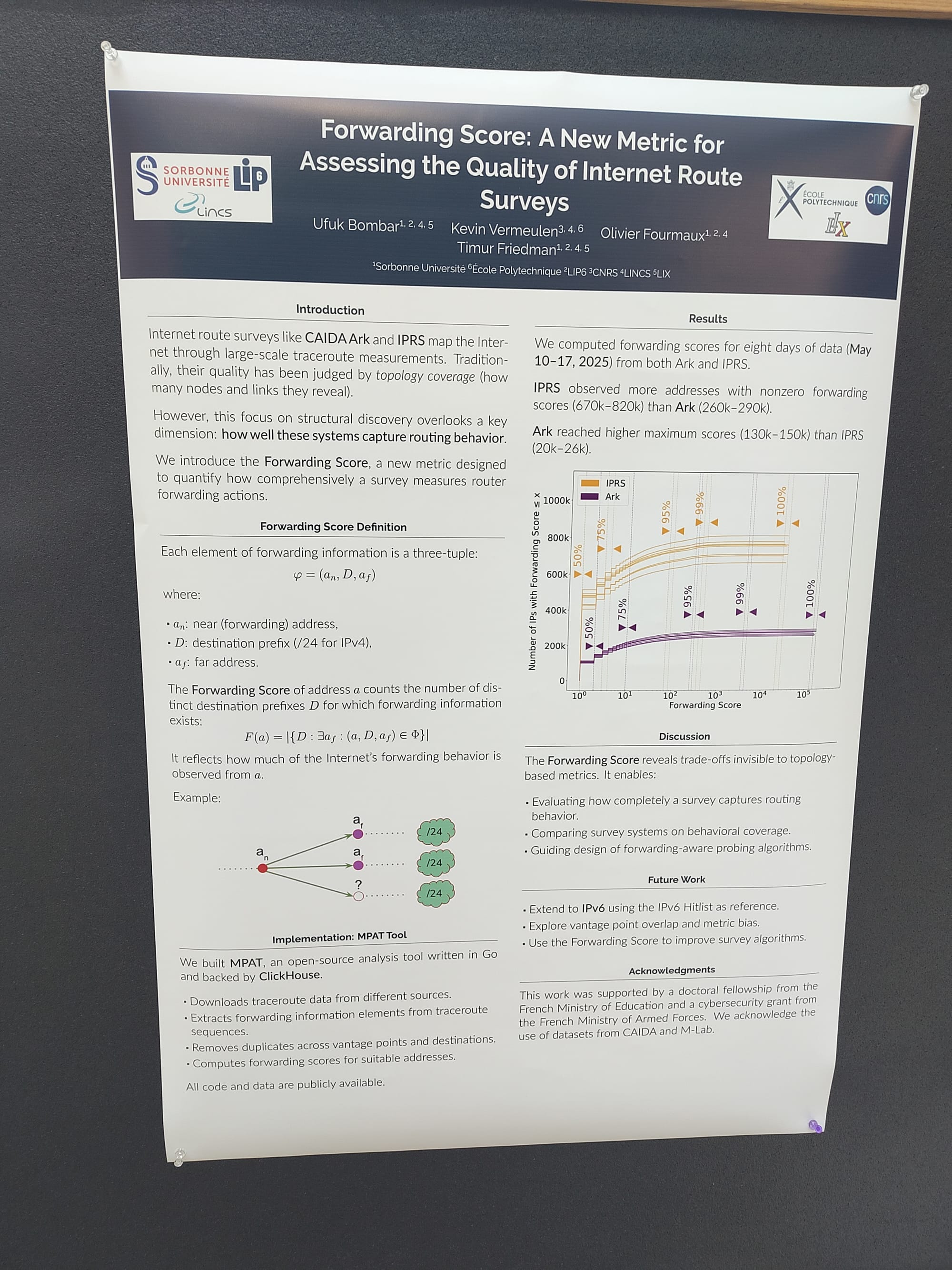
Forwarding Score: A New Metric for Assessing the Quality of Internet Route Surveys (Bombar et al.): Proposed a metric to quantify internet route survey quality.
Connecting With Academia
We were joined at the conference by Ashwin, Mert, and Shivani, three of our four 2025 summer research interns. Quite a few PhD students expressed interest in next year's summer internship — they can apply here. We’re also looking for a research scientist.
Our research is also supported by ProbeNet, our proprietary internet measurement platform, which our team uses to collect ground-truth data from a growing network of global points of presence. We welcome universities to host a ProbeNet PoP, contributing to more accurate internet infrastructure mapping and supporting academic research. Contact us if you’re interested.
Looking Ahead
The increasing presence of IPinfo in peer-reviewed research validates our core belief: better data enables better decisions, whether in fraud prevention, threat detection, or academic analysis.
And while we’re proud of our role, we’re also taking notes. Based on all the research we saw at IMC 2025, we’re evaluating next steps that push our platform further.
Share this article


About the author

As head of research at IPinfo, Oliver leads IPinfo’s research team, collaborates with academic institutions, and conducts cutting edge research.