


How VPNs Affect IVT: Understanding Risks in Digital Advertising

Get Unlimited Access to IPinfo Lite
Start using accurate IP data for cybersecurity, compliance, and personalization—no limits, no cost.
Sign up for freeInvalid traffic (IVT) is one of the most costly and misunderstood threats in digital advertising. And virtual private networks (VPNs) are making the problem worse.
As more users adopt VPNs for a multitude of reasons, ad platforms face a growing challenge: distinguishing legitimate masked traffic from sophisticated fraud. VPNs misrepresent geographic locations, obscure user identity, and make it harder to tell real users from bots or spoofed activity. The result? Wasted budgets, broken attribution, and inaccurate campaign metrics.
To stay competitive, advertisers and publishers must understand how VPNs impact IVT, and how to mitigate the risks without blocking valid users or violating privacy standards.
What is IVT?
IVT, or invalid traffic, refers to any ad impression, click, or conversion that doesn’t come from a real human user or otherwise fails quality standards for ad delivery and measurement. In other words, it’s traffic that shouldn’t count toward campaign performance. Understanding IVT is essential for anyone in adtech, because it directly affects revenue, performance metrics, and ROI.
The Trustworthy Accountability Group (TAG), the leading industry body for ad-fraud standards, defines two main categories of IVT:
- General Invalid Traffic (GIVT): Easily detected through standard filters such as IP or user-agent checks, bot lists, or declared crawlers.
- Sophisticated Invalid Traffic (SIVT): Harder to catch; involves coordinated or disguised behavior such as botnets, hijacked devices, and falsified interactions.
VPN-based IVT typically falls under SIVT, since VPNs can disguise the true origin of requests or falsify geo-data to manipulate counts.
The Media Rating Council (MRC) and TAG jointly establish the standards for detecting both GIVT and SIVT, emphasizing that sophisticated cases require deeper, evidence-based investigation.
Why Does IVT Matter?
Invalid traffic distorts nearly every metric advertisers rely on. It leads to wasted budget, inaccurate attribution, and unreliable analytics across the digital ecosystem. For publishers, it inflates impression counts without generating genuine engagement; for advertisers, it damages optimization models and ROI.
Key impacts include:
- Budget waste: Paying for impressions or clicks that will never convert.
- Corrupted analytics: Inflated reach and engagement metrics make campaigns appear healthier than they are.
- Broken attribution: Masked or falsified IP data leads to flawed performance tracking.
Because VPNs blur origin and device signals, they make IVT detection even harder, especially in programmatic systems that process billions of impressions per second.
Spot the Fakes. Reduce Ad Waste.
Use IP data to flag VPNs, proxies, and traffic anomalies.
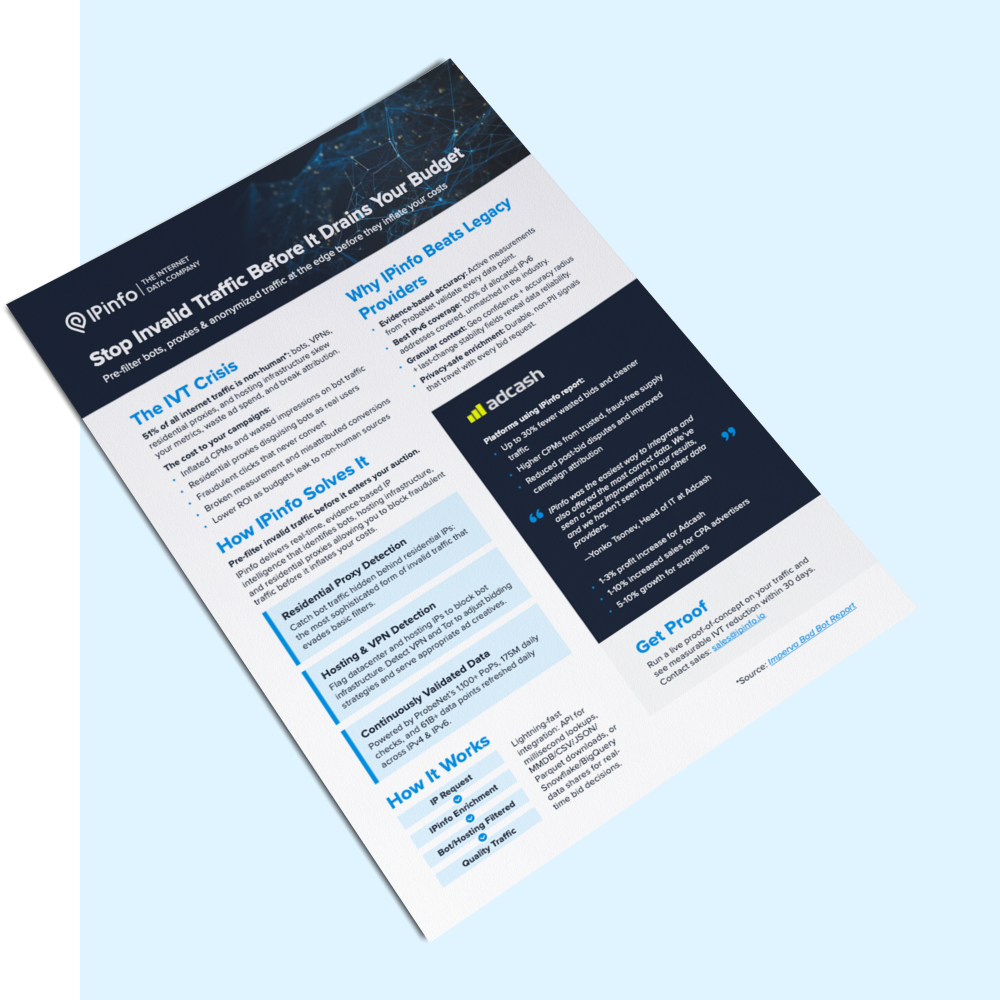
How VPNs Affect IVT Detection
Virtual private networks (VPNs) have become an essential privacy tool for users who want to hide their IP address, encrypt traffic, or bypass geo-blocking. For advertisers, however, that same privacy layer introduces serious measurement and validation challenges.
Most VPN-related risks are considered sophisticated invalid traffic and include:
Invalid Proxy Traffic
Some VPN or proxy networks are exploited by bad actors to launder bot traffic or generate fraudulent impressions through residential or mobile exit nodes. This activity fits the TAG definition of invalid proxy traffic within SIVT: traffic originating from an intermediary proxy device that manipulates counts or creates non-human requests.
Impact:
- Bots appear to originate from diverse consumer IPs, bypassing basic reputation or datacenter filters.
- Fraud rings can mimic normal browsing patterns to trigger ad impressions and clicks at scale.
IP and Geo Obfuscation
VPNs route a user’s requests through exit servers that replace the original IP and region with a different one. For geo-targeted campaigns, this causes location mismatches between the declared ad request and the real user location. In IVT classification, that constitutes location-data manipulation, a subset of SIVT.
Impact:
- Ads may appear to reach an in-market audience when they are actually served elsewhere.
- Geo-based bid multipliers and frequency controls become unreliable.
- Attribution models that depend on location or device ID lose accuracy.
Beyond these direct mismatches, the structure of VPN and proxy services makes accurate profiling impossible. A single proxy, VPN, or hosting exit node can have thousands of users behind one shared IP address, often spread across multiple continents. From an ad targeting perspective, this means those impressions cannot be effectively profiled or personalized.
Balancing Detection and Privacy
Not all VPN traffic is malicious. Many users connect through corporate VPNs or privacy-focused services. If detection systems rely solely on IP reputation or ASN lists, they risk misclassifying legitimate users as IVT, reducing reach and inflating block rates.
Industry guidance, including TAG and MRC recommendations, emphasizes multi-signal corroboration before labeling traffic invalid.
Best practice: combine IP-level metadata (e.g., is_vpn, ASN, connection type) with behavioral and contextual analysis such as dwell time, click sequence, or historical trust signals.
Estimate Your Invalid Traffic Spend
Use the Traffic Leak Audit to estimate how much of your ad spend may be reaching anonymized infrastructure.

Risks for Adtech Industry
VPN-driven SIVT poses significant financial and operational challenges across the digital advertising ecosystem. When proxy-based or location-manipulated traffic goes undetected, it distorts spend, breaks attribution, and undermines trust between buyers, sellers, and verification vendors.
Revenue and ROI Distortion
Invalid proxy traffic can generate impressions and clicks that appear authentic, but originate from automated or masked sources. This leads to:
- Wasted ad spend on non-human activity
- Artificial CPM inflation, as bots compete in auctions as if they were real users
- Reduced ROI visibility, since inflated engagement hides underperforming inventory
Attribution and Optimization Errors
VPNs and rotating proxy networks obscure user geography and device consistency, creating data mismatches across campaigns. Geo-targeted or conversion-optimized models may over- or under-report performance because they can’t link impressions to genuine regions or users.
Undermined Credibility
TAG emphasizes that consistent IVT classification and transparent reporting are vital to maintaining trust in digital advertising. When fraud is misclassified or inconsistently reported, it undermines credibility across the supply chain.
Relying on IPinfo’s evidence-based IP datasets ensures alignment with TAG’s Certified Against Fraud standards, improving transparency and auditability.
Moving Beyond IP Reputation Lists
Traditional IP blocklists and static geo-data can’t keep up with the scale and sophistication of modern IVT. That’s why most verification platforms are now adopting dynamic strategies to strengthen detection models for sophisticated invalid traffic:
- Advanced IP intelligence: Real-time datasets that identify VPN, hosting, and anonymizer infrastructure while maintaining privacy compliance.
- Behavioral analytics: Irregular session pattern detection that reveals automated or replayed traffic.
- Machine-learning models: Adaptive algorithms trained on cross-channel evidence rather than static IP lists.
For ad platforms, the challenge lies in telling the difference between privacy-seeking users and those abusing VPNs for IVT.
VPNs are not inherently fraudulent, but they expand the gray area between legitimate and invalid traffic. Effective mitigation depends on context-rich, evidence-based detection rather than blanket blocking.
How Does IPinfo Help?
Real-Time Privacy Detection
IPinfo’s datasets identifies when traffic originates from a VPN, proxy, hosting provider, Tor exit node, or relay network and more:
- Privacy service detection flags: is_vpn, is_proxy, is_tor, is_relay
- Service identification: Name of the specific service (Eg.: NordVPN)
- Timestamp: First and last time seen
- Confidence score: Scoring each VPN IP according to the methodology we used to detect it
- Source transparency: Identifying how we detected each VPN IP and if it was inferred or not. For example, we will tell you if we've observed VPN software/ports on or if we detected the VPN by directly running VPN software from almost 200 different providers and collecting exit IPs.
IPinfo focuses what matters for advertisers: contextual privacy information that indicates whether one IP potentially represents thousands of users intentionally concealing their origins. We also show the geolocation of the VPN or proxy exit IP. This provides essential compliance context and informs targeting decisions.
For example, if users from Greece, Uruguay, and Russia all choose a VPN exit node in Germany, advertisers can still select an appropriate creative language (such as German or English) based on where users choose to present themselves.
Granular Location Intelligence
IPinfo provides location signals that help assess data integrity behind VPN or masked traffic:
- geo.radius: The estimated accuracy radius of an IP’s location.
- geo.last_changed: Timestamp of the last observed location change, helpful for spotting unstable or rotating IPs typical of proxy networks.
Behavioral Context and Network Insights
Combining IPinfo’s IP metadata with platform-side engagement metrics (click paths, dwell time, conversion rate) helps build stronger machine-learning models.
- Churn and stability metrics: Frequency of AS and IP reassignment or short-lived sessions can indicate bot activity.
- Network and ASN type: Distinguishing mobile carriers from VPN backbone providers improves attribution and audience modeling.
Future Trends in IVT Detection
VPN usage and IVT sophistication continue to rise, pushing adtech toward deeper, context-aware IP intelligence rather than surface-level geo or blacklist checks. The next generation of fraud-detection systems will focus on granularity, provenance, and correlation, turning passive IP data into active, verifiable signals of authenticity.
AI-Driven Risk Models
Fraud-detection systems will combine IPinfo’s network-level signals with external behavioral and temporal signals to generate adaptive risk scores. This industry trend moves beyond binary classification toward context-weighted confidence, helping partners who build on IPinfo data differentiate legitimate corporate VPN traffic from automated proxy networks.
Granular Infrastructure Intelligence
Modern IP datasets will move beyond city-level geolocation to infrastructure-level context, identifying building-level venues, Wi-Fi networks, or enterprise locations where multiple legitimate users share an IP.Signals such as device density per IP, Wi-Fi network identifiers, or organization-specific ASN patterns can help verification platforms understand whether traffic originates from:
- a corporate VPN gateway,
- a hotel or public network, or
- a synthetic proxy cluster designed to emulate human traffic.
This level of intelligence enables SIVT differentiation separating benign privacy infrastructure from malicious spoofing networks without intruding on user privacy.
Enhanced VPN and Proxy Classification
Modern IP datasets include richer service-level metadata for VPNs and proxies such as ownership transparency, port and handshake evidence, and service type (residential, mobile, corporate, or datacenter). These granular signals allow platforms to recognize the difference between enterprise VPNs used for remote work and rotating residential proxies used to fabricate impressions or evade detection.
Privacy-First Verification
As the ecosystem shifts toward privacy-preserving measurement, IP intelligence will play a critical role in supplying network-level truth without exposing user identities. The ability to verify where and how a connection occurs, without identifying who is behind it, will define the next wave of IVT prevention and compliance innovation.
Accurate, Privacy-Safe Verification Starts Here
VPNs are reshaping the landscape of IVT, and advertisers can’t afford to ignore it.
Understanding what IVT is, and how VPNs complicate its detection, is key to protecting ad spend and maintaining data integrity. By adopting adaptive strategies and leveraging advanced IP intelligence, platforms can reduce fraud, improve targeting accuracy, and build a cleaner, more trustworthy supply chain.
Smarter AdTech Starts with Smarter IP Data
Learn how IPinfo identifies invalid traffic at scale.
Share this article


About the author

Meghan is the content strategist at IPinfo, where she develops and writes content for users to better understand the value of IP data and IPinfo products.